TAG, TITLE & REGISTER
MOTOR VEHICLES AND TRAILERS

Whether you need to transfer ownership, obtain tags, register a newly purchased vehicle, transfer existing tags, get temp tags, or complete a title-only transaction, the information below will help you determine which service best fits your situation and what documents may be required to complete your transaction.
The Maryland MVA and the Pennsylvania DMV have authorized Diversified Tag & Title Services to perform the motor vehicle services listed below on-site for cars, trucks, motorcycles, and trailers of any size when used in commercial fleets, sold at dealerships, or for personal use.
You have purchased or have been given a motor vehicle and/or trailer; it has passed a Maryland Safety Inspection, and it is time to get tags. The MVA requires that we collect excise tax, a new certificate of title fee, and registration fees for 1-year, 2-year or 3-years.
WHAT DO I NEED TO BRING WITH ME?
CUSTOMER PROVIDES
- Maryland Driver’s License Individuals
- Z# OR Corporate FEIN Businesses Currently Registered in MD
- Original Certificate of Title Signed by Previous Owner(s)
- Original Lien Release If Lien is on Title
- Original Bill of Sale See MVA Requirements
- If Placing a Lien on the Title Lienholder Name, Full Address and Loan Amount
- Maryland Safety Inspection Passed
[Exempt: Gifted, Brand New, Historic, Street Rod and K-Tags] - Insurance Information Company Name/Underwriter/Policy Number
POTENTIAL FEES
- Maryland Excise Tax
- Maryland Title Fee
- New Lien Fee If Applicable
- Tag Registration Fee 1-Year, 2-Year or 3-Year Stickers
- Our Service Fee
CUSTOMER WALKS WITH
- Maryland Excise Tax Paid
- New Certificate of Title Ordered
- New Registration w/Month and Year Stickers
- Permanent Metal License Plates
- Detailed Receipt for Services
MARYLAND DRIVERS LICENSE/ID REQUIREMENTS
To title, re-title, register and/or get tags for your motor vehicle and/or trailer in Maryland, you must have a Maryland driver’s license or Maryland identification card. Your Maryland driver’s license and identification card has a Soundex number on it; that is your MVA identification number. It is very important that you make sure that all of the information on your driver’s license or identification card is up to date.
HOW DOES THE EXCISE TAX WORK?
Excise tax is collected when transferring ownership of your newly purchased motor vehicle and/or trailer unless you are exempt from paying excise tax [see exemption list below].
The primary purpose of excise tax is to fund state transportation infrastructure. Excise tax ensures that those using the state’s roadways contribute to its upkeep and maintenance. This includes road maintenance, repair, public transit projects, traffic safety improvements and other transportation-related programs.
EXCISE TAX EXEMPTIONS:
- A mobile home is over thirty-five feet long.
- A vehicle owned by the United Sates and used in the investigation of any violation of suspected violation of the law of the United States.
- A vehicle owned by this Sate or a political subdivision of this States.
- A fire engine or other Fire Department emergency apparatus, including any vehicle operated by or in connection with any Fire Department.
- By a non-profit rescue squad.
- A vehicle owned and operated by the Civil Air Patrol.
- An ambulance, rescue or other vehicle owned and operated for the benefit of the public A vehicle owned and held for the use of the public by a unit of a national veteran’s organization.
- A vehicle owned and operated by a Maryland chapter of the American Red Cross.
- A vehicle acquired by an insurance company as a result of a comprehensive or collision claim.
- A vehicle registered in a jurisdiction that does not require titling and acquired for resale by a licensed dealer.
- A vehicle that is involuntarily transferred to a licensed dealer and for which a certificate of title is not available.
- A school bus owned by a religious organization or a private school which is exempt from federal income tax under 501 c (3) of the Internal Revenue Code.
- A privately-owned bus used only for operating the transportation system of any political subdivision in this State if the bus is used for the transportation of the public on regular schedules and between fixed terminals.
- A vehicle that is otherwise exempt for the excise tax by any other applicable law.
- A vehicle which is used regularly for the transportation of individuals with disabilities and owned by a nonprofit organization providing direct care services to individuals with disabilities which is licensed by the Department of Health and Mental Hygiene and is wholly or partially funded by the State.
- A mobile hearing and vision-screening vehicle owned and operated for the benefit of the public by a nonprofit civic organization.
- A Class F tractor or truck tractor, however a farm tractor is taxable.
- A Class P charter bus or a Class P for hire bus.
- A salvage vehicle acquired by a licensed dealer that has been restored by the licensed dealer and that has been inspected under 13-507 (a) (ii) of this certificates of title.
- A vehicle acquired for resale by a licensed dealer if the dealer reassignment sections contained on the certificate of title are exhausted.
- A Class M motor home or Class G travel trailer that is transferred or retitled in the dealership’s name under 15-305 (d) (2) of this article.
- A special purpose vehicle owned by a coal company if the vehicle is used: (i) For transportation of workers, coal, or equipment used in the coal production process; and (ii) Exclusively in or on coal mining property.
- A vehicle which is used exclusively in the transportation of disabled or elderly persons, owned by a nonprofit organization, and in which the Maryland Transit Administration retains a security interest.
- A vehicle acquired by a religious, charitable, or volunteer organization exempt from taxation under 501 c (3) of the Internal Revenue Code, the Department of Human Resources, or a local Department of Social Services for the purpose of transferring the vehicle to a Family Investment Program recipient or an individual certified by the Department of Human Resources or a local Department of Social Services as eligible for the transfer;
- A rental vehicle; or A gift.
WHEN IS A BILL OF SALE REQUIRED?
The MVA requires a bill of sale for some transactions and does not require a bill of sale for other transactions. Below we have simplified the confusing and frustrating MVA requirements for a bill of sale below.
A BILL OF SALE IS REQUIRED
- Dealership/Auction Purchase
MVA Requires Original; Signed Bill of Sale/Buyer’s Order - Private Sale for Motor Vehicle and/or Trailer 6 Years New or Newer
MVA Requires the Bill of Sale or the NADA Clean Retail Value
HB 251 and SB 125 Repealed the Notarized Bill of Sale Requirement [Oct. 1, 2026]
A BILL OF SALE IS NOT REQUIRED
- Private Sale 7 Years Old and Older
MVA Requires No Bill of Sale - Gift Transaction [Spouse to Spouse or Parent to Child]
MVA Requires No Bill of Sale
APPLYING FOR A CERTIFICATE OF TITLE
To apply for a new certificate of title for your newly purchased motor vehicle and/or trailer, you must provide the MVA with the most current certificate of title properly signed over to you by the previous owner[s]. However, if the vehicle is from a state that does not issue a certificate of title, a transferrable registration and a bill of sale must be submitted as proof of ownership when applying for a new certificate of title in Maryland.
WHAT IF THERE'S A LIEN INVOLVED?
LIEN RELEASE
If the current certificate of title to your newly purchased motor vehicle and/or trailer has a lien on it, a lien release from the lien holder [loan company] must be provided at the time of requesting a new certificate of title.
A lien release shows proof that the loan for the purchase of the motor vehicle and/or trailer has been paid off and the loan company releases the hold they had until the loan was satisfied. If the motor vehicle and/or trailer is titled in different state than Maryland, there may be a place on the title for the lienholder to sign to release the lien.
LIEN RELEASE LETTER
In lieu of a lien release, the MVA will accept an original lien release letter provided by the lienholder to release the loan from the certificate of title. The lien holder must provide an original letter on lienholder letterhead containing the items listed below to ensure that the motor vehicle and/or trailer is specifically identified and the lien can be properly released and removed from the certificate of title.
- Name of Lien Holder
- Amount of Original Loan
- Loan Account Number
- Date Lien Released
- Year, Make and Model
- Vehicle Identification Number [VIN]
- Signature of Party Releasing Lien
- Printed Name of Party Releasing Lien
- Capacity of Party Releasing Lien
- Telephone Number of Party Releasing Lien
NEW LIEN INFORMATION
If a loan was needed to buy your new or used motor vehicle and/or trailer, the lien holder [loan company] information must be placed onto the certificate of title to ensure that the lien is paid off before transferring the motor vehicle and/or trailer to a new owner. If a second lien is to be placed onto the certificate of title, the MD MVA form VR-217; Security Interest Filing must be used to add the second lien.
HOW DOES THE MARYLAND SAFETY INSPECTION WORK?
Brand new motor vehicles and/or trailers sold by an authorized dealer are not required to be safety inspected in Maryland. Your newly purchased used motor vehicle and/or trailer must be inspected at an authorized safety inspection station in Maryland. When the motor vehicle and/or trailer passes the safety inspection, the results are sent electronically to the MVA and the Maryland State Police safety enforcement website. The inspection is good for 90 days.
WHAT HAPPENS IF MOTOR VEHICLE AND/OR TRAILER FAILS SAFETY INSPECTION?
If your motor vehicle and/or trailer fails the safety inspection, you must fix the problem(s) and have the motor vehicle and/or trailer re-inspected by the same registered inspection mechanic at the same station.
- You have the option of fixing the problem yourself, having the inspection station fix the problem, or taking the vehicle to another facility for repairs.
- If the vehicle is re-inspected within 30 days after the original inspection date and you have driven it less than 1,000 miles, the inspection station will only need to inspect the defective equipment identified during the initial inspection.
- However, if a new defect is visually observed during the re-inspection, the newly discovered defect must also be repaired and re-inspected.
HOW MUCH INSURANCE DO I NEED?
You must maintain insurance on your motor vehicle with a Maryland licensed insurance provider at all times as long as tags have been issued, even if the motor vehicle is not being driven. An insurance compliance violation may result in daily fines, registration suspension, and/or tag removal. Trailers are insured under the insurance on the motor vehicle pulling it.
- Do not cancel your insurance before returning your tags. The penalties begin with an instant $200.00 fine and $7.00 a day after: not to exceed $2,500 per year.
- The Maryland Automobile Insurance Fund (MAIF) provides automobile insurance to Maryland residents that have been turned down by two insurance companies or cancelled by one. To get more information on how to insure your vehicle, click here https://www.mymarylandauto.com/site/
LIABILITY COVERAGE: This Covers the Damage You Caused
- $30,000.00 Bodily Injury Per Person,
- $60,000.00 Bodily Injury Per Accident,
- $15,000.00 Property Damage [Per Accident]
UNINSURED MOTORIST COVERAGE: Protects You if the Other Driver Has Little or No Insurance.
- $30,000.00/$60,000.00 Bodily Injury
- $15,000.00 Property Damage
PERSONAL LIABILITY PROTECTION: This Covers Medical Expenses and Lost Wages
- $2,500.00 Minium Per Person
INSURANCE CARD:
Maryland law requires all drivers of a motor vehicle must possess a current insurance identification card issued by their insurance carrier to be presented when requested by law enforcement. It may be in tangible (paper, plastic, etc.) or in an electronic format [via email on phone].
WHAT IS VEHICLE EMISSIONS TESTING?
Maryland requires eligible vehicles to pass an emissions inspection every two years through the Vehicle Emissions Inspection Program [VEIP] This is a mandatory clean air initiative administered by the MVA and the Department of the Environment. A notice to have your motor vehicle emissions tested will arrive about 8 weeks before the inspection is due.
WHICH COUNTIES ARE REQUIRED TO TEST
VEIP is not required statewide. Below counties must be tested.
- Anne Arundel, Baltimore, Baltimore City, Calvert, Carroll, Cecil, Charles, Frederick, Harford, Howard, Montgomery, Prince George’s, Queen Anne’s, and Washington counties
WHICH COUNTIES IN MARYLAND NOT REQUIRED TO TEST
Allegany, Caroline, Dorchester, Garrett, Kent, Somerset, St. Mary’s, Talbot, Wicomico, or Worcester county.
WHAT VEHICLES MUST BE TESTED?
- Most passenger vehicles, light-duty trucks, and heavy-duty vehicles must be tested.
WHERE IS VEIP TESTING?
- Self-Service Kiosk: Kiosks are available 24/7 across the state. You plug an OBD cable into your vehicle to run the diagnostic test.
- VEIP Station: Visit any of the 18 centralized inspection stations. Appointments are not required.
VEHICLE EMISSIONS EXEMPTIONS:
- 1976 or older.
- Vehicles that weigh more than 26,000 pounds gross vehicle weight.
- Vehicles powered solely by diesel or electric.
- Motorcycle.
- Vehicles registered as a farm truck, farm truck tractor, or farm area vehicle.
- Historic or Antique vehicles.
- New vehicles; First 24 months and qualified hybrids for the first 36 months after titling and registration.
- Fire apparatus owned/leased by the State of Maryland, a county, municipality, volunteer fire department, or rescue squad.
- Ambulances currently exempted will remain exempt.
- Vehicles Registered to Senior Citizens w/Qualified Emissions Waiver. Mileage must be recertified every two years to continue to receive the waiver.
- Vehicles registered as a Class N street rod vehicle.
- A military vehicle owned by the federal government and used for tactical, combat, or relief operations, or for training for these operations.
- Vehicles registered as a Class H school vehicle or Class P passenger bus.
- Complete the reverse side of the VEIP inspection form (form #EP-1) certifying that you meet the criteria listed above. Mail the form to the MVA attention VEIP or hand deliver it to any VEIP Station.
FAILED TESTS, WAIVERS, AND EXTENSIONS
If your vehicle fails the test, you must have the required repairs completed by a Certified Emissions Repair Facility and bring the car back for a re-inspection within 120 days. [1]
- Waiver: If you spend at least $450 on qualifying repairs and your vehicle still fails, you may qualify for a 2-year waiver.
- Extensions: If you need more time, you can apply for an extension online.
WHAT IF THE VEHICLE IS A GIFT?
MVA GIFT REQUIREMENTS
- Must Be a Maryland Title
- Last Names of Giver and Receiver Are the Same, OR
- Proof of Relationship [i.e., Birth, Marriage, Divorce/Death Certificate]
- No Monetary or Other Valuable Consideration May Be Involved in the Transfer
GIFT BENEFITS
- No Excise Tax is Collected
- No Inspection is Required
- Current Tags May be Transferred
CUSTOMER PROVIDES
- Maryland Driver’s License Individuals
- Original Certificate of Title Signed by Previous Owner(s)
- Original Lien Release If Lien is on Title
- MVA Does Not Require a Bill of Sale
- Original MVA VR-103 Gift Application
- Insurance Information Company Name/Underwriter/Policy Number
POTENTIAL FEES
- NO Maryland Excise Tax is Paid Exempt
- Maryland Title Fee
- Tag Transfer Fee Unless Renewal is Needed
- Our Service Fee
CUSTOMER WALKS WITH
- NO Maryland Excise Tax Paid
- New Certificate of Title Ordered
- Current Tags Transferred
- Detailed Receipt for Services
You have purchased or have been given a motor vehicle or trailer; it has passed Maryland Safety Inspection, and you have tags to transfer to your motor vehicle and/or trailer. The MVA requires that we collect excise tax, a new certificate of title fee, and registration fees for 1-year, 2-year or 3-years.
WHAT DO I NEED TO BRING WITH ME?
CUSTOMER PROVIDES
- Maryland Driver’s License Individuals
- Z# OR Corporate FEIN Businesses Currently Registered in MD
- Original Certificate of Title Signed by Previous Owner(s)
- Original Lien Release If Lien is on Title
- Original Bill of Sale See MVA Requirements
- If Placing a Lien on the Title Lienholder Name, Full Address and Loan Amount
- Maryland Safety Inspection Passed
[Exempt: Gifted, Brand New, Historic, Street Rod and K-Tags] - Insurance Information Company Name/Underwriter/Policy Number
POTENTIAL FEES
- Maryland Excise Tax
- Maryland Title Fee
- New Lien Fee If Applicable
- Tag Registration Fee 1-Year, 2-Year or 3-Year Stickers
- Our Service Fee
CUSTOMER WALKS WITH
- Maryland Excise Tax Paid
- New Certificate of Title Ordered
- New Registration w/Month and Year Stickers
- Permanent Metal License Plates
- Detailed Receipt for Services
MARYLAND DRIVERS LICENSE/ID REQUIREMENTS
To title, re-title, register and/or get tags for your motor vehicle and/or trailer in Maryland, you must have a Maryland driver’s license or Maryland identification card. Your Maryland driver’s license and identification card has a Soundex number on it; that is your MVA identification number. It is very important that you make sure that all of the information on your driver’s license or identification card is up to date.
HOW DOES THE EXCISE TAX WORK?
Excise tax is collected when transferring ownership of your newly purchased motor vehicle and/or trailer unless you are exempt from paying excise tax [see exemption list below].
The primary purpose of excise tax is to fund state transportation infrastructure. Excise tax ensures that those using the state’s roadways contribute to its upkeep and maintenance. This includes road maintenance, repair, public transit projects, traffic safety improvements and other transportation-related programs.
EXCISE TAX EXEMPTIONS:
- A mobile home is over thirty-five feet long.
- A vehicle owned by the United Sates and used in the investigation of any violation of suspected violation of the law of the United States.
- A vehicle owned by this Sate or a political subdivision of this States.
- A fire engine or other Fire Department emergency apparatus, including any vehicle operated by or in connection with any Fire Department.
- By a non-profit rescue squad.
- A vehicle owned and operated by the Civil Air Patrol.
- An ambulance, rescue or other vehicle owned and operated for the benefit of the public A vehicle owned and held for the use of the public by a unit of a national veteran’s organization.
- A vehicle owned and operated by a Maryland chapter of the American Red Cross.
- A vehicle acquired by an insurance company as a result of a comprehensive or collision claim.
- A vehicle registered in a jurisdiction that does not require titling and acquired for resale by a licensed dealer.
- A vehicle that is involuntarily transferred to a licensed dealer and for which a certificate of title is not available.
- A school bus owned by a religious organization or a private school which is exempt from federal income tax under 501 c (3) of the Internal Revenue Code.
- A privately-owned bus used only for operating the transportation system of any political subdivision in this State if the bus is used for the transportation of the public on regular schedules and between fixed terminals.
- A vehicle that is otherwise exempt for the excise tax by any other applicable law.
- A vehicle which is used regularly for the transportation of individuals with disabilities and owned by a nonprofit organization providing direct care services to individuals with disabilities which is licensed by the Department of Health and Mental Hygiene and is wholly or partially funded by the State.
- A mobile hearing and vision-screening vehicle owned and operated for the benefit of the public by a nonprofit civic organization.
- A Class F tractor or truck tractor, however a farm tractor is taxable.
- A Class P charter bus or a Class P for hire bus.
- A salvage vehicle acquired by a licensed dealer that has been restored by the licensed dealer and that has been inspected under 13-507 (a) (ii) of this certificates of title.
- A vehicle acquired for resale by a licensed dealer if the dealer reassignment sections contained on the certificate of title are exhausted.
- A Class M motor home or Class G travel trailer that is transferred or retitled in the dealership’s name under 15-305 (d) (2) of this article.
- A special purpose vehicle owned by a coal company if the vehicle is used: (i) For transportation of workers, coal, or equipment used in the coal production process; and (ii) Exclusively in or on coal mining property.
- A vehicle which is used exclusively in the transportation of disabled or elderly persons, owned by a nonprofit organization, and in which the Maryland Transit Administration retains a security interest.
- A vehicle acquired by a religious, charitable, or volunteer organization exempt from taxation under 501 c (3) of the Internal Revenue Code, the Department of Human Resources, or a local Department of Social Services for the purpose of transferring the vehicle to a Family Investment Program recipient or an individual certified by the Department of Human Resources or a local Department of Social Services as eligible for the transfer;
- A rental vehicle; or A gift.
WHEN IS A BILL OF SALE REQUIRED?
The MVA requires a bill of sale for some transactions and does not require a bill of sale for other transactions. Below we have simplified the confusing and frustrating MVA requirements for a bill of sale below.
A BILL OF SALE IS REQUIRED
- Dealership/Auction Purchase
MVA Requires Original; Signed Bill of Sale/Buyer’s Order - Private Sale for Motor Vehicle and/or Trailer 6 Years New or Newer
MVA Requires the Bill of Sale or the NADA Clean Retail Value
HB 251 and SB 125 Repealed the Notarized Bill of Sale Requirement [Oct. 1, 2026]
A BILL OF SALE IS NOT REQUIRED
- Private Sale 7 Years Old and Older
MVA Requires No Bill of Sale - Gift Transaction [Spouse to Spouse or Parent to Child]
MVA Requires No Bill of Sale
APPLYING FOR A CERTIFICATE OF TITLE
To apply for a new certificate of title for your newly purchased motor vehicle and/or trailer, you must provide the MVA with the most current certificate of title properly signed over to you by the previous owner[s]. However, if the vehicle is from a state that does not issue a certificate of title, a transferrable registration and a bill of sale must be submitted as proof of ownership when applying for a new certificate of title in Maryland.
WHAT IF THERE IS A LIEN INVOLVED?
LIEN RELEASE
If the current certificate of title to your newly purchased motor vehicle and/or trailer has a lien on it, a lien release from the lien holder [loan company] must be provided at the time of requesting a new certificate of title.
A lien release shows proof that the loan for the purchase of the motor vehicle and/or trailer has been paid off and the loan company releases the hold they had until the loan was satisfied. If the motor vehicle and/or trailer is titled in different state than Maryland, there may be a place on the title for the lienholder to sign to release the lien.
LIEN RELEASE LETTER
In lieu of a lien release, the MVA will accept an original lien release letter provided by the lienholder to release the loan from the certificate of title. The lien holder must provide an original letter on lienholder letterhead containing the items listed below to ensure that the motor vehicle and/or trailer is specifically identified and the lien can be properly released and removed from the certificate of title.
- Name of Lien Holder
- Amount of Original Loan
- Loan Account Number
- Date Lien Released
- Year, Make and Model
- Vehicle Identification Number [VIN]
- Signature of Party Releasing Lien
- Printed Name of Party Releasing Lien
- Capacity of Party Releasing Lien
- Telephone Number of Party Releasing Lien
NEW LIEN INFORMATION
If a loan was needed to buy your new or used motor vehicle and/or trailer, the lien holder [loan company] information must be placed onto the certificate of title to ensure that the lien is paid off before transferring the motor vehicle and/or trailer to a new owner. If a second lien is to be placed onto the certificate of title, the MD MVA form VR-217; Security Interest Filing must be used to add the second lien.
HOW DOES THE MARYLAND SAFETY INSPECTION WORK?
Brand new motor vehicles and/or trailers sold by an authorized dealer are not required to be safety inspected in Maryland. Your newly purchased used motor vehicle and/or trailer must be inspected at an authorized safety inspection station in Maryland. When the motor vehicle and/or trailer passes the safety inspection, the results are sent electronically to the MVA and the Maryland State Police safety enforcement website. The inspection is good for 90 days.
WHAT HAPPENS IF MOTOR VEHICLE AND/OR TRAILER FAILS SAFETY INSPECTION?
If your motor vehicle and/or trailer fails the safety inspection, you must fix the problem(s) and have the motor vehicle and/or trailer re-inspected by the same registered inspection mechanic at the same station.
- You have the option of fixing the problem yourself, having the inspection station fix the problem, or taking the vehicle to another facility for repairs.
- If the vehicle is re-inspected within 30 days after the original inspection date and you have driven it less than 1,000 miles, the inspection station will only need to inspect the defective equipment identified during the initial inspection.
- However, if a new defect is visually observed during the re-inspection, the newly discovered defect must also be repaired and re-inspected.
HOW MUCH INSURANCE DO I NEED?
You must maintain insurance on your motor vehicle with a Maryland licensed insurance provider at all times as long as tags have been issued, even if the motor vehicle is not being driven. An insurance compliance violation may result in daily fines, registration suspension, and/or tag removal. Trailers are insured under the insurance on the motor vehicle pulling it.
- Do not cancel your insurance before returning your tags. The penalties begin with an instant $200.00 fine and $7.00 a day after: not to exceed $2,500 per year.
- The Maryland Automobile Insurance Fund (MAIF) provides automobile insurance to Maryland residents that have been turned down by two insurance companies or cancelled by one. To get more information on how to insure your vehicle, click here https://www.mymarylandauto.com/site/
LIABILITY COVERAGE: This Covers the Damage You Caused
- $30,000.00 Bodily Injury Per Person,
- $60,000.00 Bodily Injury Per Accident,
- $15,000.00 Property Damage [Per Accident]
UNINSURED MOTORIST COVERAGE: Protects You if the Other Driver Has Little or No Insurance.
- $30,000.00/$60,000.00 Bodily Injury
- $15,000.00 Property Damage
PERSONAL LIABILITY PROTECTION: This Covers Medical Expenses and Lost Wages
- $2,500.00 Minium Per Person
INSURANCE CARD:
Maryland law requires all drivers of a motor vehicle must possess a current insurance identification card issued by their insurance carrier to be presented when requested by law enforcement. It may be in tangible (paper, plastic, etc.) or in an electronic format [via email on phone].
WHAT IS VEHICLE EMISSIONS TESTING?
Maryland requires eligible vehicles to pass an emissions inspection every two years through the Vehicle Emissions Inspection Program [VEIP] This is a mandatory clean air initiative administered by the MVA and the Department of the Environment. A notice to have your motor vehicle emissions tested will arrive about 8 weeks before the inspection is due.
WHICH COUNTIES ARE REQUIRED TO TEST
VEIP is not required statewide. Below counties must be tested.
- Anne Arundel, Baltimore, Baltimore City, Calvert, Carroll, Cecil, Charles, Frederick, Harford, Howard, Montgomery, Prince George’s, Queen Anne’s, and Washington counties
WHICH COUNTIES IN MARYLAND NOT REQUIRED TO TEST
Allegany, Caroline, Dorchester, Garrett, Kent, Somerset, St. Mary’s, Talbot, Wicomico, or Worcester county.
WHAT VEHICLES MUST BE TESTED?
- Most passenger vehicles, light-duty trucks, and heavy-duty vehicles must be tested.
WHERE IS VEIP TESTING?
- Self-Service Kiosk: Kiosks are available 24/7 across the state. You plug an OBD cable into your vehicle to run the diagnostic test.
- VEIP Station: Visit any of the 18 centralized inspection stations. Appointments are not required.
VEHICLE EMISSIONS EXEMPTIONS:
- 1976 or older.
- Vehicles that weigh more than 26,000 pounds gross vehicle weight.
- Vehicles powered solely by diesel or electric.
- Motorcycle.
- Vehicles registered as a farm truck, farm truck tractor, or farm area vehicle.
- Historic or Antique vehicles.
- New vehicles; First 24 months and qualified hybrids for the first 36 months after titling and registration.
- Fire apparatus owned/leased by the State of Maryland, a county, municipality, volunteer fire department, or rescue squad.
- Ambulances currently exempted will remain exempt.
- Vehicles Registered to Senior Citizens w/Qualified Emissions Waiver. Mileage must be recertified every two years to continue to receive the waiver.
- Vehicles registered as a Class N street rod vehicle.
- A military vehicle owned by the federal government and used for tactical, combat, or relief operations, or for training for these operations.
- Vehicles registered as a Class H school vehicle or Class P passenger bus.
- Complete the reverse side of the VEIP inspection form (form #EP-1) certifying that you meet the criteria listed above. Mail the form to the MVA attention VEIP or hand deliver it to any VEIP Station.
FAILED TESTS, WAIVERS, & EXTENSIONS
If your vehicle fails the test, you must have the required repairs completed by a Certified Emissions Repair Facility and bring the car back for a re-inspection within 120 days. [1]
- Waiver: If you spend at least $450 on qualifying repairs and your vehicle still fails, you may qualify for a 2-year waiver.
- Extensions: If you need more time, you can apply for an extension online.
You have purchased or have been given a motor vehicle and/or trailer, and you need to get it to an authorized Maryland Safety Inspection station to be inspected. The MVA requires that we collect excise tax, a new certificate of title fee, and registration fees for 1-year, 2-year or 3-years.
WHAT DO I NEED TO BRING WITH ME?
CUSTOMER PROVIDES
- Maryland Driver’s License Individuals
- Z# OR Corporate FEIN Businesses Currently Registered in MD
- Original Certificate of Title Signed by Previous Owner(s)
- Original Lien Release If Lien is on Title
- Original Bill of Sale See MVA Requirements
- If Placing a Lien on the Title Lienholder Name, Full Address and Loan Amount
- Insurance Information Company Name, Underwriter/Policy Number
- Maryland Safety Inspection:
- Exempt Are Gifted, Brand New, Historic, Street Rod and K-Tags
- One [1] 30-Day Registration Issued – No Extensions and No Exceptions
POTENTIAL FEES
- Maryland Excise Tax
- Maryland Title Fee
- New Lien Fee If Applicable
- Tag Transfer Fee Unless Renewal is Needed
- Our Service Fee
CUSTOMER WALKS WITH
- Maryland Excise Tax Paid
- New Certificate of Title Ordered
- New Lien Added If Applicable
- Permanent Metal License Plates
- 30-Day Original Registration w/Month and Year Stickers
- Detailed Receipt for Services
MARYLAND DRIVERS LICENSE/ID REQUIREMENTS
To title, re-title, register and/or get tags for your motor vehicle and/or trailer in Maryland, you must have a Maryland driver’s license or Maryland identification card. Your Maryland driver’s license and identification card has a Soundex number on it; that is your MVA identification number. It is very important that you make sure that all of the information on your driver’s license or identification card is up to date.
HOW DOES THE EXCISE TAX WORK?
Excise tax is collected when transferring ownership of your newly purchased motor vehicle and/or trailer unless you are exempt from paying excise tax [see exemption list below].
The primary purpose of excise tax is to fund state transportation infrastructure. Excise tax ensures that those using the state’s roadways contribute to its upkeep and maintenance. This includes road maintenance, repair, public transit projects, traffic safety improvements and other transportation-related programs.
EXCISE TAX EXEMPTIONS:
- A mobile home is over thirty-five feet long.
- A vehicle owned by the United Sates and used in the investigation of any violation of suspected violation of the law of the United States.
- A vehicle owned by this Sate or a political subdivision of this States.
- A fire engine or other Fire Department emergency apparatus, including any vehicle operated by or in connection with any Fire Department.
- By a non-profit rescue squad.
- A vehicle owned and operated by the Civil Air Patrol.
- An ambulance, rescue or other vehicle owned and operated for the benefit of the public A vehicle owned and held for the use of the public by a unit of a national veteran’s organization.
- A vehicle owned and operated by a Maryland chapter of the American Red Cross.
- A vehicle acquired by an insurance company as a result of a comprehensive or collision claim.
- A vehicle registered in a jurisdiction that does not require titling and acquired for resale by a licensed dealer.
- A vehicle that is involuntarily transferred to a licensed dealer and for which a certificate of title is not available.
- A school bus owned by a religious organization or a private school which is exempt from federal income tax under 501 c (3) of the Internal Revenue Code.
- A privately-owned bus used only for operating the transportation system of any political subdivision in this State if the bus is used for the transportation of the public on regular schedules and between fixed terminals.
- A vehicle that is otherwise exempt for the excise tax by any other applicable law.
- A vehicle which is used regularly for the transportation of individuals with disabilities and owned by a nonprofit organization providing direct care services to individuals with disabilities which is licensed by the Department of Health and Mental Hygiene and is wholly or partially funded by the State.
- A mobile hearing and vision-screening vehicle owned and operated for the benefit of the public by a nonprofit civic organization.
- A Class F tractor or truck tractor, however a farm tractor is taxable.
- A Class P charter bus or a Class P for hire bus.
- A salvage vehicle acquired by a licensed dealer that has been restored by the licensed dealer and that has been inspected under 13-507 (a) (ii) of this certificates of title.
- A vehicle acquired for resale by a licensed dealer if the dealer reassignment sections contained on the certificate of title are exhausted.
- A Class M motor home or Class G travel trailer that is transferred or retitled in the dealership’s name under 15-305 (d) (2) of this article.
- A special purpose vehicle owned by a coal company if the vehicle is used: (i) For transportation of workers, coal, or equipment used in the coal production process; and (ii) Exclusively in or on coal mining property.
- A vehicle which is used exclusively in the transportation of disabled or elderly persons, owned by a nonprofit organization, and in which the Maryland Transit Administration retains a security interest.
- A vehicle acquired by a religious, charitable, or volunteer organization exempt from taxation under 501 c (3) of the Internal Revenue Code, the Department of Human Resources, or a local Department of Social Services for the purpose of transferring the vehicle to a Family Investment Program recipient or an individual certified by the Department of Human Resources or a local Department of Social Services as eligible for the transfer;
- A rental vehicle; or A gift.
WHEN IS A BILL OF SALE REQUIRED?
The MVA requires a bill of sale for some transactions and does not require a bill of sale for other transactions. Below we have simplified the confusing and frustrating MVA requirements for a bill of sale below.
A BILL OF SALE IS REQUIRED
- Dealership/Auction Purchase
MVA Requires Original; Signed Bill of Sale/Buyer’s Order - Private Sale for Motor Vehicle and/or Trailer 6 Years New or Newer
MVA Requires the Bill of Sale or the NADA Clean Retail Value
HB 251 and SB 125 Repealed the Notarized Bill of Sale Requirement [Oct. 1, 2026]
A BILL OF SALE IS NOT REQUIRED
- Private Sale 7 Years Old and Older
MVA Requires No Bill of Sale - Gift Transaction [Spouse to Spouse or Parent to Child]
MVA Requires No Bill of Sale
APPLYING FOR A CERTIFICATE OF TITLE
To apply for a new certificate of title for your newly purchased motor vehicle and/or trailer, you must provide the MVA with the most current certificate of title properly signed over to you by the previous owner[s]. However, if the vehicle is from a state that does not issue a certificate of title, a transferrable registration and a bill of sale must be submitted as proof of ownership when applying for a new certificate of title in Maryland.
WHAT IF THERE IS A LIEN INVOLVED?
LIEN RELEASE
If the current certificate of title to your newly purchased motor vehicle and/or trailer has a lien on it, a lien release from the lien holder [loan company] must be provided at the time of requesting a new certificate of title.
A lien release shows proof that the loan for the purchase of the motor vehicle and/or trailer has been paid off and the loan company releases the hold they had until the loan was satisfied. If the motor vehicle and/or trailer is titled in different state than Maryland, there may be a place on the title for the lienholder to sign to release the lien.
LIEN RELEASE LETTER
In lieu of a lien release, the MVA will accept an original lien release letter provided by the lienholder to release the loan from the certificate of title. The lien holder must provide an original letter on lienholder letterhead containing the items listed below to ensure that the motor vehicle and/or trailer is specifically identified and the lien can be properly released and removed from the certificate of title.
- Name of Lien Holder
- Amount of Original Loan
- Loan Account Number
- Date Lien Released
- Year, Make and Model
- Vehicle Identification Number [VIN]
- Signature of Party Releasing Lien
- Printed Name of Party Releasing Lien
- Capacity of Party Releasing Lien
- Telephone Number of Party Releasing Lien
NEW LIEN INFORMATION
If a loan was needed to buy your new or used motor vehicle and/or trailer, the lien holder [loan company] information must be placed onto the certificate of title to ensure that the lien is paid off before transferring the motor vehicle and/or trailer to a new owner. If a second lien is to be placed onto the certificate of title, the MD MVA form VR-217; Security Interest Filing must be used to add the second lien.
HOW DOES THE MARYLAND SAFETY INSPECTION WORK?
Brand new motor vehicles and/or trailers sold by an authorized dealer are not required to be safety inspected in Maryland. Your newly purchased used motor vehicle and/or trailer must be inspected at an authorized safety inspection station in Maryland. When the motor vehicle and/or trailer passes the safety inspection, the results are sent electronically to the MVA and the Maryland State Police safety enforcement website. The inspection is good for 90 days. [See exempt list below]
MARYLAND SAFETY INSPECTION EXEMPTIONS:
- Brand New
- Gifted.
- Historic.
- Street Rod
- Farm Area
- Island Vehicle
WHAT HAPPENS IF MOTOR VEHICLE AND/OR TRAILER FAILS SAFETY INSPECTION?
If your motor vehicle and/or trailer fails the safety inspection, you must fix the problem(s) and have the motor vehicle and/or trailer re-inspected by the same registered inspection mechanic at the same station.
- You have the option of fixing the problem yourself, having the inspection station fix the problem, or taking the vehicle to another facility for repairs.
- If the vehicle is re-inspected within 30 days after the original inspection date and you have driven it less than 1,000 miles, the inspection station will only need to inspect the defective equipment identified during the initial inspection.
- However, if a new defect is visually observed during the re-inspection, the newly discovered defect must also be repaired and re-inspected.
HOW MUCH INSURANCE DO I NEED?
You must maintain insurance on your motor vehicle with a Maryland licensed insurance provider at all times as long as tags have been issued, even if the motor vehicle is not being driven. An insurance compliance violation may result in daily fines, registration suspension, and/or tag removal. Trailers are insured under the insurance on the motor vehicle pulling it.
- Do not cancel your insurance before returning your tags. The penalties begin with an instant $200.00 fine and $7.00 a day after: not to exceed $2,500 per year.
- The Maryland Automobile Insurance Fund (MAIF) provides automobile insurance to Maryland residents that have been turned down by two insurance companies or cancelled by one. To get more information on how to insure your vehicle, click here https://www.mymarylandauto.com/site/
LIABILITY COVERAGE: This Covers the Damage You Caused
- $30,000.00 Bodily Injury Per Person,
- $60,000.00 Bodily Injury Per Accident,
- $15,000.00 Property Damage [Per Accident]
UNINSURED MOTORIST COVERAGE: Protects You if the Other Driver Has Little or No Insurance.
- $30,000.00/$60,000.00 Bodily Injury
- $15,000.00 Property Damage
PERSONAL LIABILITY PROTECTION: This Covers Medical Expenses and Lost Wages
- $2,500.00 Minium Per Person
INSURANCE CARD:
Maryland law requires all drivers of a motor vehicle must possess a current insurance identification card issued by their insurance carrier to be presented when requested by law enforcement. It may be in tangible (paper, plastic, etc.) or in an electronic format [via email on phone].
WHAT IS VEHICLE EMISSIONS TESTING?
Maryland requires eligible vehicles to pass an emissions inspection every two years through the Vehicle Emissions Inspection Program [VEIP] This is a mandatory clean air initiative administered by the MVA and the Department of the Environment. A notice to have your motor vehicle emissions tested will arrive about 8 weeks before the inspection is due.
WHICH COUNTIES ARE REQUIRED TO TEST
VEIP is not required statewide. Below counties must be tested.
- Anne Arundel, Baltimore, Baltimore City, Calvert, Carroll, Cecil, Charles, Frederick, Harford, Howard, Montgomery, Prince George’s, Queen Anne’s, and Washington counties
WHICH COUNTIES IN MARYLAND NOT REQUIRED TO TEST
Allegany, Caroline, Dorchester, Garrett, Kent, Somerset, St. Mary’s, Talbot, Wicomico, or Worcester county.
WHAT VEHICLES MUST BE TESTED?
- Most passenger vehicles, light-duty trucks, and heavy-duty vehicles must be tested.
WHERE IS VEIP TESTING?
- Self-Service Kiosk: Kiosks are available 24/7 across the state. You plug an OBD cable into your vehicle to run the diagnostic test.
- VEIP Station: Visit any of the 18 centralized inspection stations. Appointments are not required.
VEHICLE EMISSIONS EXEMPTIONS:
- 1976 or older.
- Vehicles that weigh more than 26,000 pounds gross vehicle weight.
- Vehicles powered solely by diesel or electric.
- Motorcycle.
- Vehicles registered as a farm truck, farm truck tractor, or farm area vehicle.
- Historic or Antique vehicles.
- New vehicles; First 24 months and qualified hybrids for the first 36 months after titling and registration.
- Fire apparatus owned/leased by the State of Maryland, a county, municipality, volunteer fire department, or rescue squad.
- Ambulances currently exempted will remain exempt.
- Vehicles Registered to Senior Citizens w/Qualified Emissions Waiver. Mileage must be recertified every two years to continue to receive the waiver.
- Vehicles registered as a Class N street rod vehicle.
- A military vehicle owned by the federal government and used for tactical, combat, or relief operations, or for training for these operations.
- Vehicles registered as a Class H school vehicle or Class P passenger bus.
- Complete the reverse side of the VEIP inspection form (form #EP-1) certifying that you meet the criteria listed above. Mail the form to the MVA attention VEIP or hand deliver it to any VEIP Station.
FAILED TESTS, WAIVERS, & EXTENSIONS
If your vehicle fails the test, you must have the required repairs completed by a Certified Emissions Repair Facility and bring the car back for a re-inspection within 120 days. [1]
- Waiver: If you spend at least $450 on qualifying repairs and your vehicle still fails, you may qualify for a 2-year waiver.
- Extensions: If you need more time, you can apply for an extension online.
You have purchased or have been given a motor vehicle and/or trailer. You do not want to put tags on the vehicle at this time. The MVA requires that we collect excise tax, a new certificate of title fee, and registration fees for 1-year, 2-year or 3-years.
WHAT DO I NEED TO BRING WITH ME?
CUSTOMER PROVIDES
- Maryland Driver’s License Individuals
- Z# OR Corporate FEIN Businesses Currently Registered in MD
- Original Certificate of Title Signed by Previous Owner(s)
- Original Lien Release If Lien is on Title
- Original Bill of Sale See MVA Requirements
- If Placing a Lien on the Title Lienholder Name, Full Address and Loan Amount
- Maryland Safety Inspection Passed
[Exempt: Gifted, Brand New, Historic, Street Rod and K-Tags] - Insurance Information Company Name/Underwriter/Policy Number
POTENTIAL FEES
- Maryland Excise Tax
- Maryland Title Fee
- New Lien Fee If Applicable
- Tag Registration Fee 1-Year, 2-Year or 3-Year Stickers
- Our Service Fee
CUSTOMER WALKS WITH
- Maryland Excise Tax Paid
- New Certificate of Title Ordered
- New Registration w/Month and Year Stickers
- Permanent Metal License Plates
- Detailed Receipt for Services
MARYLAND DRIVERS LICENSE/ID REQUIREMENTS
To title, re-title, register and/or get tags for your motor vehicle and/or trailer in Maryland, you must have a Maryland driver’s license or Maryland identification card. Your Maryland driver’s license and identification card has a Soundex number on it; that is your MVA identification number. It is very important that you make sure that all of the information on your driver’s license or identification card is up to date.
HOW DOES THE EXCISE TAX WORK?
Excise tax is collected when transferring ownership of your newly purchased motor vehicle and/or trailer unless you are exempt from paying excise tax [see exemption list below].
The primary purpose of excise tax is to fund state transportation infrastructure. Excise tax ensures that those using the state’s roadways contribute to its upkeep and maintenance. This includes road maintenance, repair, public transit projects, traffic safety improvements and other transportation-related programs.
EXCISE TAX EXEMPTIONS:
- A mobile home is over thirty-five feet long.
- A vehicle owned by the United Sates and used in the investigation of any violation of suspected violation of the law of the United States.
- A vehicle owned by this Sate or a political subdivision of this States.
- A fire engine or other Fire Department emergency apparatus, including any vehicle operated by or in connection with any Fire Department.
- By a non-profit rescue squad.
- A vehicle owned and operated by the Civil Air Patrol.
- An ambulance, rescue or other vehicle owned and operated for the benefit of the public A vehicle owned and held for the use of the public by a unit of a national veteran’s organization.
- A vehicle owned and operated by a Maryland chapter of the American Red Cross.
- A vehicle acquired by an insurance company as a result of a comprehensive or collision claim.
- A vehicle registered in a jurisdiction that does not require titling and acquired for resale by a licensed dealer.
- A vehicle that is involuntarily transferred to a licensed dealer and for which a certificate of title is not available.
- A school bus owned by a religious organization or a private school which is exempt from federal income tax under 501 c (3) of the Internal Revenue Code.
- A privately-owned bus used only for operating the transportation system of any political subdivision in this State if the bus is used for the transportation of the public on regular schedules and between fixed terminals.
- A vehicle that is otherwise exempt for the excise tax by any other applicable law.
- A vehicle which is used regularly for the transportation of individuals with disabilities and owned by a nonprofit organization providing direct care services to individuals with disabilities which is licensed by the Department of Health and Mental Hygiene and is wholly or partially funded by the State.
- A mobile hearing and vision-screening vehicle owned and operated for the benefit of the public by a nonprofit civic organization.
- A Class F tractor or truck tractor, however a farm tractor is taxable.
- A Class P charter bus or a Class P for hire bus.
- A salvage vehicle acquired by a licensed dealer that has been restored by the licensed dealer and that has been inspected under 13-507 (a) (ii) of this certificates of title.
- A vehicle acquired for resale by a licensed dealer if the dealer reassignment sections contained on the certificate of title are exhausted.
- A Class M motor home or Class G travel trailer that is transferred or retitled in the dealership’s name under 15-305 (d) (2) of this article.
- A special purpose vehicle owned by a coal company if the vehicle is used: (i) For transportation of workers, coal, or equipment used in the coal production process; and (ii) Exclusively in or on coal mining property.
- A vehicle which is used exclusively in the transportation of disabled or elderly persons, owned by a nonprofit organization, and in which the Maryland Transit Administration retains a security interest.
- A vehicle acquired by a religious, charitable, or volunteer organization exempt from taxation under 501 c (3) of the Internal Revenue Code, the Department of Human Resources, or a local Department of Social Services for the purpose of transferring the vehicle to a Family Investment Program recipient or an individual certified by the Department of Human Resources or a local Department of Social Services as eligible for the transfer;
- A rental vehicle; or A gift.
WHEN IS A BILL OF SALE REQUIRED?
The MVA requires a bill of sale for some transactions and does not require a bill of sale for other transactions. Below we have simplified the confusing and frustrating MVA requirements for a bill of sale below.
A BILL OF SALE IS REQUIRED
- Dealership/Auction Purchase
MVA Requires Original; Signed Bill of Sale/Buyer’s Order - Private Sale for Motor Vehicle and/or Trailer 6 Years New or Newer
MVA Requires the Bill of Sale or the NADA Clean Retail Value
HB 251 and SB 125 Repealed the Notarized Bill of Sale Requirement [Oct. 1, 2026]
A BILL OF SALE IS NOT REQUIRED
- Private Sale 7 Years Old and Older
MVA Requires No Bill of Sale - Gift Transaction [Spouse to Spouse or Parent to Child]
MVA Requires No Bill of Sale
APPLYING FOR A CERTIFICATE OF TITLE
To apply for a new certificate of title for your newly purchased motor vehicle and/or trailer, you must provide the MVA with the most current certificate of title properly signed over to you by the previous owner[s]. However, if the vehicle is from a state that does not issue a certificate of title, a transferable registration and a bill of sale must be submitted as proof of ownership when applying for a new certificate of title in Maryland.
WHAT IF THERE IS A LIEN INVOLVED?
LIEN RELEASE
If the current certificate of title to your newly purchased motor vehicle and/or trailer has a lien on it, a lien release from the lien holder [loan company] must be provided at the time of requesting a new certificate of title.
A lien release shows proof that the loan for the purchase of the motor vehicle and/or trailer has been paid off and the loan company releases the hold they had until the loan was satisfied. If the motor vehicle and/or trailer is titled in different state than Maryland, there may be a place on the title for the lienholder to sign to release the lien.
LIEN RELEASE LETTER
In lieu of a lien release, the MVA will accept an original lien release letter provided by the lienholder to release the loan from the certificate of title. The lien holder must provide an original letter on lienholder letterhead containing the items listed below to ensure that the motor vehicle and/or trailer is specifically identified and the lien can be properly released and removed from the certificate of title.
- Name of Lien Holder
- Amount of Original Loan
- Loan Account Number
- Date Lien Released
- Year, Make and Model
- Vehicle Identification Number [VIN]
- Signature of Party Releasing Lien
- Printed Name of Party Releasing Lien
- Capacity of Party Releasing Lien
- Telephone Number of Party Releasing Lien
NEW LIEN INFORMATION
If a loan was needed to buy your new or used motor vehicle and/or trailer, the lien holder [loan company] information must be placed onto the certificate of title to ensure that the lien is paid off before transferring the motor vehicle and/or trailer to a new owner. If a second lien is to be placed onto the certificate of title, the MD MVA form VR-217; Security Interest Filing must be used to add the second lien.
HOW DOES THE MARYLAND SAFETY INSPECTION WORK?
Brand new motor vehicles and/or trailers sold by an authorized dealer are not required to be safety inspected in Maryland. Your newly purchased used motor vehicle and/or trailer must be inspected at an authorized safety inspection station in Maryland. When the motor vehicle and/or trailer passes the safety inspection, the results are sent electronically to the MVA and the Maryland State Police safety enforcement website. The inspection is good for 90 days. [See exempt list below]
MARYLAND SAFETY INSPECTION EXEMPTIONS:
- Brand New
- Gifted.
- Historic.
- Street Rod
- Farm Area
- Island Vehicle
WHAT HAPPENS IF MOTOR VEHICLE AND/OR TRAILER FAILS SAFETY INSPECTION?
If your motor vehicle and/or trailer fails the safety inspection, you must fix the problem(s) and have the motor vehicle and/or trailer re-inspected by the same registered inspection mechanic at the same station.
- You have the option of fixing the problem yourself, having the inspection station fix the problem, or taking the vehicle to another facility for repairs.
- If the vehicle is re-inspected within 30 days after the original inspection date and you have driven it less than 1,000 miles, the inspection station will only need to inspect the defective equipment identified during the initial inspection.
- However, if a new defect is visually observed during the re-inspection, the newly discovered defect must also be repaired and re-inspected.
HOW MUCH INSURANCE DO I NEED?
You must maintain insurance on your motor vehicle with a Maryland licensed insurance provider at all times as long as tags have been issued, even if the motor vehicle is not being driven. An insurance compliance violation may result in daily fines, registration suspension, and/or tag removal. Trailers are insured under the insurance on the motor vehicle pulling it.
- Do not cancel your insurance before returning your tags. The penalties begin with an instant $200.00 fine and $7.00 a day after: not to exceed $2,500 per year.
- The Maryland Automobile Insurance Fund (MAIF) provides automobile insurance to Maryland residents that have been turned down by two insurance companies or cancelled by one. To get more information on how to insure your vehicle, click here https://www.mymarylandauto.com/site/
LIABILITY COVERAGE: This Covers the Damage You Caused
- $30,000.00 Bodily Injury Per Person,
- $60,000.00 Bodily Injury Per Accident,
- $15,000.00 Property Damage [Per Accident]
UNINSURED MOTORIST COVERAGE: Protects You if the Other Driver Has Little or No Insurance.
- $30,000.00/$60,000.00 Bodily Injury
- $15,000.00 Property Damage
PERSONAL LIABILITY PROTECTION: This Covers Medical Expenses and Lost Wages
- $2,500.00 Minium Per Person
INSURANCE CARD:
Maryland law requires all drivers of a motor vehicle must possess a current insurance identification card issued by their insurance carrier to be presented when requested by law enforcement. It may be in tangible (paper, plastic, etc.) or in an electronic format [via email on phone].
WHAT IS VEHICLE EMISSIONS TESTING?
Maryland requires eligible vehicles to pass an emissions inspection every two years through the Vehicle Emissions Inspection Program [VEIP] This is a mandatory clean air initiative administered by the MVA and the Department of the Environment. A notice to have your motor vehicle emissions tested will arrive about 8 weeks before the inspection is due.
WHICH COUNTIES ARE REQUIRED TO TEST
VEIP is not required statewide. Below counties must be tested.
- Anne Arundel, Baltimore, Baltimore City, Calvert, Carroll, Cecil, Charles, Frederick, Harford, Howard, Montgomery, Prince George’s, Queen Anne’s, and Washington counties
WHICH COUNTIES IN MARYLAND NOT REQUIRED TO TEST
- Allegany, Caroline, Dorchester, Garrett, Kent, Somerset, St. Mary’s, Talbot, Wicomico, or Worcester county.
WHAT VEHICLES MUST BE TESTED?
- Most passenger vehicles, light-duty trucks, and heavy-duty vehicles must be tested.
WHERE IS VEIP TESTING?
- Self-Service Kiosk: Kiosks are available 24/7 across the state. You plug an OBD cable into your vehicle to run the diagnostic test.
- VEIP Station: Visit any of the 18 centralized inspection stations. Appointments are not required.
VEHICLE EMISSIONS EXEMPTIONS:
- 1976 or older.
- Vehicles that weigh more than 26,000 pounds gross vehicle weight.
- Vehicles powered solely by diesel or electric.
- Motorcycle.
- Vehicles registered as a farm truck, farm truck tractor, or farm area vehicle.
- Historic or Antique vehicles.
- New vehicles; First 24 months and qualified hybrids for the first 36 months after titling and registration.
- Fire apparatus owned/leased by the State of Maryland, a county, municipality, volunteer fire department, or rescue squad.
- Ambulances currently exempted will remain exempt.
- Vehicles Registered to Senior Citizens w/Qualified Emissions Waiver. Mileage must be recertified every two years to continue to receive the waiver.
- Vehicles registered as a Class N street rod vehicle.
- A military vehicle owned by the federal government and used for tactical, combat, or relief operations, or for training for these operations.
- Vehicles registered as a Class H school vehicle or Class P passenger bus.
- Complete the reverse side of the VEIP inspection form (form #EP-1) certifying that you meet the criteria listed above. Mail the form to the MVA attention VEIP or hand deliver it to any VEIP Station.
FAILED TESTS, WAIVERS, AND EXTENSIONS
If your vehicle fails the test, you must have the required repairs completed by a Certified Emissions Repair Facility and bring the car back for a re-inspection within 120 days. [1]
- Waiver: If you spend at least $450 on qualifying repairs and your vehicle still fails, you may qualify for a 2-year waiver.
- Extensions: If you need more time, you can apply for an extension online.
- Senior citizen emissions waiver
- Disabled citizen emissions waiver
- Repair Waiver
You have purchased or have been given a motor vehicle and/or trailer, and you paid the excise tax and ordered a new title but . . .
- It would not pass inspection, and you needed time to perform the repairs. The repairs are done and it is time for tags.
- You planned to sell it without registering and tagging it. You changed your mind and now it is time for tags.
- You took it off the road, removed the tags and now you want to get tags again.
- New permanent metal license plates, new registration card and registration stickers both [month/year] are provided.
- Fees for a New Registration only are determined by the class and weight of the motor vehicle and/or trailer [1-year, 2-year or 3-year options].
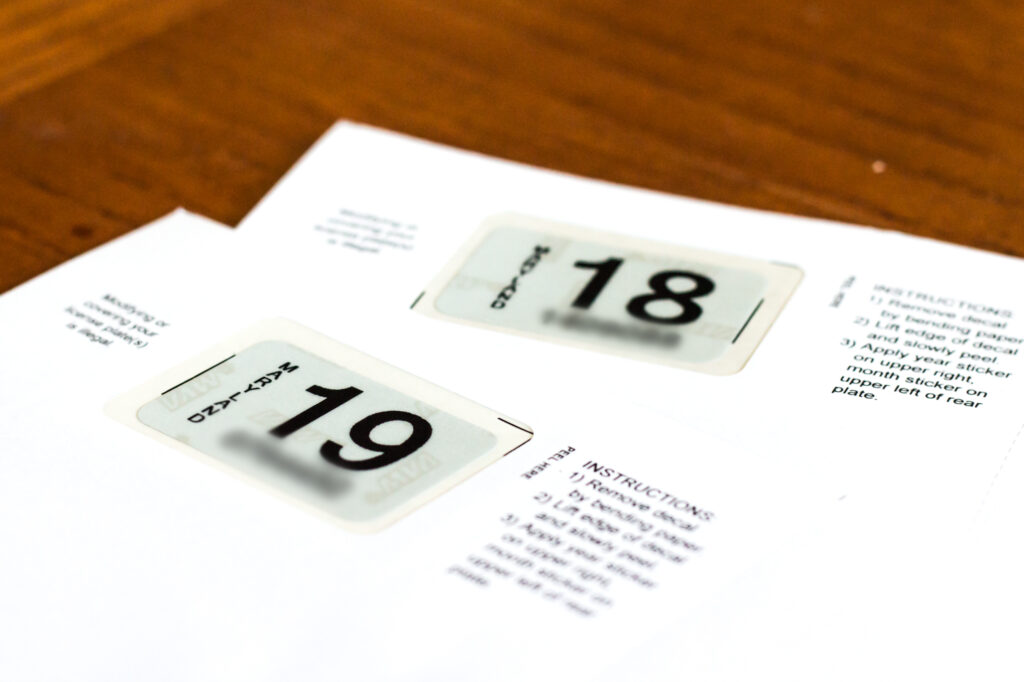
- If the motor vehicle and/or trailer is sold, traded or junked and have no plans on transferring the tags, return them as soon as possible and have them properly removed from the MVA system to avoid an insurance compliance violation.The fees for registering and tagging are determined by the class and weight of the motor vehicle and/or trailer. The motor vehicle administration offers 1-year, 2-year or 3-year options. The owners will be issued a new registration card, new metal permanent tags and new month/year sticker for the rear tag.
WHAT DO I NEED TO BRING WITH ME?
CUSTOMER PROVIDES
- Maryland Driver’s License
- VIN, Title # or Tag #
POTENTIAL FEES
- Dependent on Weight and Class of Motor Vehicle and/or Trailer
- Registration Fee [1 Year, 2 Years or 3 Years]
CUSTOMER WALKS WITH
- New Registration Card
- New Registration Year Sticker
- Detailed Receipt for Services
MARYLAND DRIVERS LICENSE/ID REQUIREMENTS
To title, re-title, register and/or get tags for your motor vehicle and/or trailer in Maryland, you must have a Maryland driver’s license or Maryland identification card. Your Maryland driver’s license and identification card has a Soundex number on it; that is your MVA identification number. It is very important that you make sure the information on your driver’s license or identification card is up to date.
EMERGENCY SERVICES
- Maryland Emergency Medical System Operations Fund
- Maryland’s world-renowned trauma and emergency management system
- Maryland State Police Aviation Command
- R Adams Cowley Shock Trauma Center
- Maryland Fire and Rescue
ROAD AND HIGHWAY MAINTENANCE
- Paving and highway repairs
- Snow removal and road treatments
- Bridge maintenance and safety upgrades
TRAFFIC SAFETY AND OPERATIONS
- Traffic signals and signage
- Highway patrol and safety programs
- Accident reduction initiatives
PUBLIC TRANSPORTATION
- Local bus systems
- MARC commuter rail
- Metro support
TRANSPORTATION TRUST FUND
- Statewide transportation projects
- Local road funding
- Long-term infrastructure planning
LOCAL GOVERNMENT
- Local road repairs
- Traffic improvements
- Street maintenance
ENVIRONMENTAL PROGRAMS
- Vehicle emissions programs
- Air quality compliance
- Motor vehicles meet environmental standards
MVA OPERATIONS
- Running the motor vehicle administration
- Collecting excise tax and processing registration and titles
- Customer service centers
- IT systems and enforcement
DRIVER AND MOTOR VEHICLE INFORMATION
- Personal Information is correct
- Motor vehicle and/or trailer information is up to date
- Insurance information on record is current
- Flags and Violations are cleared
- Confirm owner[s] of the motor vehicle and/or trailer
When a non-resident of Maryland [individual or business] purchases a motor vehicle and/or trailer in Maryland, the MVA allows us to issue a temporary paper In-Transit tag that provides the new owner 14 days to move the motor vehicle and/or trailer to their state of residence. Only one in-transit tag may be issued for any vehicle to the same buyer.
CUSTOMER PROVIDES
- Home State Driver’s License [Individuals]
- Corporate FEIN OR MVA Z Number [Businesses]
- Original Maryland Title
- Original Lien Release [If Applicable]
- Proof of Insurance w/Motor Vehicle and/or Trailer On it
POTENTIAL FEES
- In-Transit Tag Fee
- Our Services Fee
CUSTOMER WALKS WITH
- In-Transit Tag [Paper – 14-Days]
- Original Maryland Certificate of Title
- Original Lien Release [If Applicable]
- Detailed Receipt for Services

Posted on Google
 Chuck Sperati
Trustindex verifies that the original source of the review is Google.
After visiting here, I cannot imagine why anyone would ever go to the MVA. Not only is there no waiting around, but the people behind the counter are actually friendly and knowledgeable. Not only was I able to return my tags, but they noted that I qualified for a partial refund on my registration and filled out the paperwork for me. You don't get this type of service at the MVA.Posted on Google Spiro MAlways a great experience and they went out of there way for me to make a title rightPosted on Google
 Jennifer ForbergExcellent customer service!Posted on Google
 Ellen LowmanFast and quick servicePosted on Google
 adam hellerLiterally 20 minutes in and out, with every question answered, new tags in hand.Posted on Google
 James ScottPosted on Google
 Dave & Kim MillsNo line! In and out in minutes. They process Maine trailer tags for Maryland residents. We haven't been back to MVA to register any of our vehicles or trailers since we discovered Diversified. Staff is very nice!Posted on Google
 VickiThis is the only Tag and Title place I would go to. It's in a nice area, the people there are quick, helpful and really seem to know what they are doing. The owner waited on me yesterday. Very pleasant and certainly is very knowledgeable. It saved me loads of time instead of being at the DMV half a day. Thank you for being professional and rapid time in accomplishing what I needed.Posted on Google
 Amigos LandscapingPosted on Google
 Brittany FischerSo helpful I was transferring my car from Pa to Md they were so helpful my name was spelled wrong after getting my stuff back they were able to get it done all in the same day for me much appreciated for helping me out definitely would use them againShowing only 5 star reviews